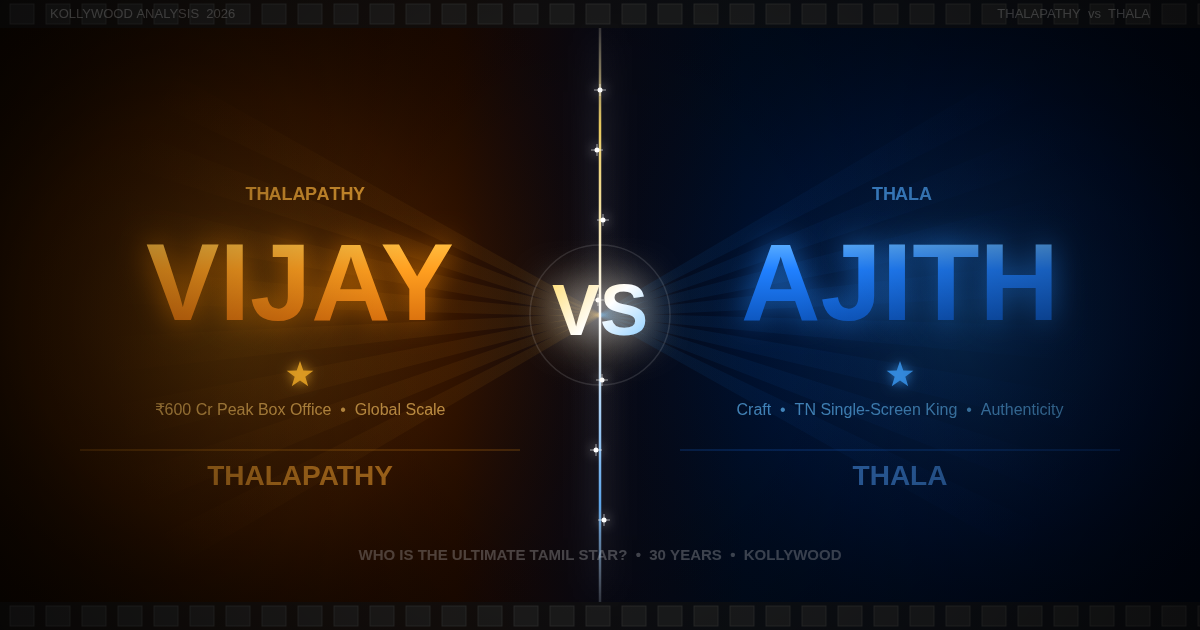
Vijay vs Ajith: Who Is the Ultimate Tamil Star?
For two decades, this debate has run hotter than any box office clash. Vijay or Ajith — who is the biggest Tamil star? Both debuted in 1992. Both have ruled Kollywood for over 30 years. Both command fan bases that cross continents. But with Vijay stepping into politics and Ajith still commanding the big screen in 2026, the answer is more layered than any fan war admits.
The short answer: Vijay leads on commercial metrics and global scale; Ajith leads on craft, personal respect, and Tamil Nadu’s single-screen loyalty. But neither answer is complete without the data behind it.
This article breaks down career records, box office performance, fan culture, acting range, and cultural legacy — using real numbers and honest analysis — so you can decide for yourself.
How Did Both Stars Build Their Careers Over 30 Years?
Vijay and Ajith both debuted in 1992 and have sustained genuine A-list stardom for over three decades — a feat almost no other Tamil actor has matched in the same era. Their paths, however, were strikingly different.
Vijay, known to fans as Thalapathy (Commander), made his debut with Naalaiya Theerpu (1992). His early years leaned into family-oriented, emotionally safe films. The commercial reinvention came in the mid-2000s. Ghilli (2004) gave him an action-mass identity. Pokkiri (2007) cemented it. By Thuppakki (2012), he had evolved into the defining mass entertainer of his generation — high-energy action, spectacular dance sequences, crowd-pleasing dialogue, and a formula that scaled from Tamil Nadu to global Tamil diaspora markets reliably.
Ajith Kumar, known as Thala (Leader), debuted in the same year with En Veedu En Kanavar. His early career was defined by emotional romanticism — Aasai (1995) and Kadhal Mannan (1998) built him a devoted, sentiment-driven fan base. He reinvented himself in the 2000s with grittier, more morally complex roles. Mankatha (2011), where he played a corrupt anti-hero, is still cited as one of Kollywood’s most charismatic villain performances. Vedalam (2015), Vivegam (2017), Viswasam (2019), and Nerkonda Paarvai (2019) showed an actor willing to change his formula across phases rather than repeat it.
What separates both men from the wave of actors who couldn’t sustain their peaks is real audience connection — not just studios, marketing, or manufactured hype.
Career Snapshot: Vijay vs Ajith Side by Side
| Category | Vijay — Thalapathy | Ajith Kumar — Thala |
|---|---|---|
| Debut Year | 1992 | 1992 |
| Fan Title Meaning | Commander | Leader |
| Career Films (approx.) | 68+ | 62+ |
| Biggest Box Office Hit | Leo (2023) | Viswasam (2019) |
| Estimated Peak Worldwide Gross | ₹600+ crore (Leo) | ₹200–250 crore (Viswasam) |
| Career Strengths | Dance, mass entertainment, global reach | Craft, emotional range, TN single-screen |
| Social Media | Massive (fan-driven) | None — no personal accounts |
| Outside Cinema | Politics (TVK party, 2024) | Motorsport (F2 racing, Le Mans) |
| Last Known Film | GOAT (2024) | Vidaamuyarchi (2025) |
Who Wins at the Box Office — Vijay or Ajith?
On peak grossing records, Vijay holds a clear lead. On Tamil Nadu single-screen dominance, Ajith has surprised even industry veterans.
Vijay’s box office run from 2012 to 2024 is one of the strongest in Indian commercial cinema. Thuppakki, Mersal, Bigil, Master, Beast, Leo, and GOAT each crossed ₹200 crore worldwide, with several crossing ₹400–600 crore. Leo (2023), directed by Lokesh Kanagaraj within the Lokesh Cinematic Universe, is estimated to have crossed ₹600 crore globally — placing it among the highest-grossing Tamil films ever made. GOAT (2024), his final film before politics, added significantly to that cumulative total.
Ajith’s numbers are consistently strong, especially relative to production budgets. Viswasam (2019), a family-emotional drama with relatively modest production values, collected over ₹200 crore and crucially outperformed Vijay’s Petta — starring Rajinikanth — in Tamil Nadu’s theatrical circuit during the same Pongal release window. That result shocked industry analysts who had expected Petta to dominate. Valimai (2022) and Thunivu (2023) added to a pattern of reliable commercial returns.
The 2019 Pongal clash between Viswasam and Petta remains a key data point in this debate. Ajith’s emotional, roots-first storytelling clearly resonates more deeply with Tamil Nadu’s single-screen audience when placed in direct competition. Vijay’s formula, meanwhile, scales internationally with more consistency.
The honest takeaway: Vijay delivers bigger numbers across wider markets. Ajith delivers higher loyalty per ticket in Tamil Nadu. Both are commercially bankable — just at different scales and in different contexts.
Fan Culture: What Makes Thala vs Thalapathy Different?
Tamil film fan culture is unlike anything in most global entertainment markets. These are not casual supporters — they are organised, territorial, and emotionally invested in ways that directly affect opening-day box office and cultural conversation.
Vijay’s fan base is the most structurally organised in Kollywood. The Vijay Fans Association (VFA) runs chapters across Tamil Nadu, other Indian states, Malaysia, Sri Lanka, the UAE, the UK, and North America. Fan events built around film releases and Vijay’s birthday consistently include large-scale charitable activities — free food distribution, blood donation drives, tree planting initiatives — that have improved how Tamil fan culture is perceived by the general public. On social media, Vijay-related hashtags dominate Twitter/X during release seasons; his fan pages collectively hold tens of millions of followers across platforms.
Ajith’s fan base operates differently — with less size, but arguably more intensity. Ajith has no personal social media accounts. He gives almost no media interviews. He avoids public appearances outside professional commitments. Fans don’t admire him through a carefully managed media persona — they admire him through his films and the private reputation he has earned for being genuinely humble. When Ajith’s fans speak about why they follow him, the language shifts from entertainment to respect. That distinction matters in measuring a star’s true depth of connection.
In global digital reach, Vijay leads comfortably. In the quality of emotional loyalty within Tamil Nadu, the gap between the two narrows considerably.
Acting Craft and Screen Presence: Who Has the Edge?
This is where honest analysis tends to diverge from fan camp allegiance. The two stars have built very different types of screen identity.
Vijay has evolved more visibly as an entertainer. Early in his career, critics noted that he prioritised commercial formula over character depth. That criticism has softened. Theri (2016) showed genuine emotional access as a father-led revenge story. Master (2021) gave him a flawed, drinking, morally complicated professor — a deliberate departure from his clean-hero image. Leo leaned further into moral ambiguity. His dancing ability remains unmatched among Tamil stars of his generation; the choreography sequences in Bigil and Mersal set benchmarks that newer actors still study.
Ajith is consistently assessed by critics as the stronger pure actor. His performance in Nerkonda Paarvai (2019), a Tamil remake of the Hindi courtroom drama Pink, earned widespread critical praise for restrained, mature delivery — he played a morally complex lawyer navigating consent and social justice, a subject matter that demands actual craft rather than presence. His villain arc in Mankatha is one of the few commercial Tamil performances studied seriously in acting discussions. He has also shown willingness to take roles where the character fails, suffers, or loses — a risk many commercial stars avoid.
Among film critics and cinema scholars who study Kollywood, Ajith receives higher marks for craft and range. Among mainstream audiences prioritising entertainment output, Vijay often wins on energy and spectacle. The distinction is not a hierarchy — it is a difference in what each actor optimises for.
Beyond Cinema: Legacy, Politics, and Life Outside Films
A star’s actual size in Indian culture cannot be measured purely by films. What they represent — and what they choose to do with that representation — matters enormously.
Vijay’s entry into electoral politics in 2024 marked the most significant star-to-politician transition in Tamil Nadu since the MGR era. He launched Tamilaga Vettri Kazhagam (TVK) with clear intent to contest the 2026 Tamil Nadu state assembly elections, announcing his retirement from cinema to focus entirely on public service. Whether TVK achieves political success remains an open question — Tamil Nadu’s political landscape is complex, with DMK and AIADMK holding deep institutional roots. But the transition itself signals the scale of Vijay’s perceived influence. No Tamil actor since M. G. Ramachandran — the legendary star who became Chief Minister and reshaped Tamil Nadu’s political history — has made such a move with comparable national attention.
Ajith’s legacy outside cinema is built on discipline and authenticity rather than scale. He is the only Tamil film star to have competed seriously in international motorsport — racing in Formula 2 and participating in endurance events connected to the 24 Hours of Le Mans series. He pursued this not as a publicity exercise but as a legitimate competitive venture, training and racing alongside professional drivers. For millions of fans, this made him a symbol of someone who pursues personal passion with conviction, regardless of what the film industry expects from its biggest names.
Ajith has also spoken publicly about treating cinema as a profession rather than an identity — a counterculture stance in an industry that routinely mythologises its stars. That authenticity has translated into a form of cultural respect that outlasts individual films.
Vijay’s political move, if it yields even moderate success, makes him the more historically significant figure in Tamil Nadu’s public life. Ajith’s non-film achievements make him the more authentically unconventional one.
Common Myths This Debate Keeps Repeating
Several persistent misconceptions shape how people argue about Vijay and Ajith. It is worth addressing the most common ones directly.
Myth: The star with more box office hits is definitively bigger. Box office reflects market conditions, release dates, competition, and marketing spend — not just star power alone. When Viswasam outperformed a Rajinikanth film during Pongal 2019 with a fraction of the promotional budget, that said something real about audience emotional connection that raw numbers cannot fully capture.
Myth: Vijay moving to politics means he lost to Ajith. This misreads the situation entirely. Tamil Nadu has a documented tradition of cinema stars transitioning to public service — MGR and Jayalalithaa both began in film. Vijay’s political move reflects expanded ambition, not industry retreat.
Myth: This debate has a definitive winner. It doesn’t. They excel on different axes. Vijay leads on box office peak, global reach, and social media presence. Ajith leads on craft, personal reputation, and Tamil Nadu single-screen loyalty. Declaring one “winner” requires choosing which axis matters most — and reasonable people disagree on that.
Myth: Social media fan numbers equal real star power. Online following can be inflated, bot-amplified, and difficult to verify. The genuine measure of a Tamil star is their ability to open a film on Day 1 — to drive ticket sales from audience goodwill alone, before any reviews land. Both Vijay and Ajith have demonstrated consistent opening-day power for over two decades. That is the standard that matters.
FAQ — Vijay vs Ajith: Answering What People Actually Ask
Who has a bigger fan base — Vijay or Ajith? Vijay’s fan base is larger in terms of organised chapters, social media numbers, and global geographic spread. Ajith’s fan base is smaller but frequently described as more intensely loyal. In Tamil Nadu specifically, Ajith fans have repeatedly demonstrated their ability to outperform box office expectations — as seen with Viswasam in 2019. Online size and real-world loyalty are different measurements.
Who has the higher career box office record between Vijay and Ajith? Vijay holds the higher peak grossing record. Leo (2023) reportedly crossed ₹600 crore globally. Ajith’s biggest earner, Viswasam, is estimated at ₹200–250 crore worldwide. In terms of cumulative career box office, Vijay also leads significantly, though Ajith’s films consistently deliver strong returns relative to their production and marketing budgets.
Is Vijay still acting in 2026? As of 2026, Vijay has stepped back from active cinema to focus on politics through his party TVK (Tamilaga Vettri Kazhagam). His last film was GOAT (The Greatest of All Time, 2024). He has not announced any new film projects and has publicly committed to contesting Tamil Nadu’s 2026 state assembly elections.
Why is Ajith called Thala? Thala means “leader” or “head” in Tamil. The nickname emerged organically from fan communities in the early 2000s, reflecting both Ajith’s screen authority and the deep personal respect fans hold for him. Unlike many star titles that are actively promoted through media, “Thala” stuck through genuine grassroots fan sentiment.
Who is the better actor — Vijay or Ajith? Critical opinion generally favours Ajith for range, restraint, and willingness to take unconventional roles (Mankatha, Nerkonda Paarvai). Vijay is celebrated more for screen charisma, dancing, and commercial entertainment value (Mersal, Bigil, Leo). Both have delivered excellent performances — they simply prioritise different kinds of excellence.
What has Ajith Kumar done outside Tamil cinema? Ajith has competed seriously in international motorsport, including Formula 2 racing and endurance events in the Le Mans racing circuit. He trained and raced professionally alongside career drivers — not as a celebrity guest, but as a competitor. He is also known for avoiding social media entirely and maintaining a private, grounded personal life that stands apart from typical film-star culture.
Will Vijay and Ajith ever act together in a film? This remains one of Tamil cinema’s most-requested collaborations. As of 2026, with Vijay focused on politics and both stars being equivalent A-list billing, the chances appear very low in the near term. It has never materialised across their parallel 30-year careers.
Who came first — Vijay or Ajith in Tamil cinema? Both debuted in 1992. Ajith’s En Veedu En Kanavar and Vijay’s Naalaiya Theerpu released the same year. Ajith gained mainstream recognition slightly earlier in the mid-1990s with hits like Aasai (1995), while Vijay’s breakthrough came closer to the early 2000s.
Conclusion: Who Is the Biggest Tamil Star in 2026?
If one answer is required: Vijay is the bigger star by commercial scale — peak box office numbers, international reach, social media presence, and historical cultural impact through his political transition. Ajith is the more respected figure — in acting craft, personal character, and the quality of loyalty he commands within Tamil Nadu.
The gap between those two things is smaller than any fan war acknowledges.
What is beyond debate: Tamil cinema would not be what it is today without both of them. Their 30-year parallel careers kept Kollywood commercially robust, exported Tamil storytelling to global screens, and gave generations of fans something to argue passionately about — which, in its own way, is the clearest proof of how much they both matter.
For anyone new to Tamil cinema, the best entry point is straightforward. Watch Vijay in Mersal or Master. Watch Ajith in Vedalam or Nerkonda Paarvai. Then decide what kind of star you value most.
The debate doesn’t need a winner. It needs an audience.
Stay informed and ahead of the game—our top reads will give you the confidence you need