Top 10 Tamil Music Composers of All Time
Tamil film music is one of the most distinctive sonic traditions on the planet. It blends Carnatic classical roots, folk rhythms, Western orchestration, and electronic production in ways that no other industry does.
But who built that sound?
This guide ranks the 10 greatest Tamil music composers of all time — covering every era from the 1930s pioneers to today’s streaming-era superstars. The ranking weighs creative legacy, commercial dominance, technical innovation, and long-term cultural impact. Not just hit counts.
Whether you are new to Tamil cinema or a lifelong fan, these are the names that define the art form.
Who Is Considered the Greatest Tamil Music Composer of All Time?
Ilaiyaraaja is widely considered the greatest Tamil music composer of all time. With over 1,000 film scores across five decades, he revolutionised Tamil film music by fusing Western classical orchestration with Carnatic and folk traditions — a combination that no one had attempted at that scale before him.
That said, A.R. Rahman’s global reach and M.S. Viswanathan’s golden-age dominance make this a genuinely competitive conversation — and one worth having in full.
The Top 10 Tamil Music Composers: Quick Comparison
| Rank | Composer | Active Era | Films Scored | Signature Style | Global Recognition |
|---|---|---|---|---|---|
| 1 | Ilaiyaraaja | 1976–present | 1,000+ | Western classical + Carnatic fusion | Knight of the French Order of Arts |
| 2 | A.R. Rahman | 1992–present | 100+ Tamil | World music, electronic, orchestral | 2× Academy Awards, 2× Grammy Awards |
| 3 | M.S. Viswanathan | 1954–2000s | 700+ | Melodic Tamil folk, light classical | Padma Bhushan (2017) |
| 4 | K.V. Mahadevan | 1950–1980s | 600+ | Classical Carnatic, devotional | National Film Award winner |
| 5 | Harris Jayaraj | 2000–present | 60+ | Melodic rock, lush orchestration | Youth favorite across South India |
| 6 | Yuvan Shankar Raja | 1997–present | 150+ | Hip-hop, electronica, melody | Five Filmfare Awards South |
| 7 | Anirudh Ravichander | 2012–present | 80+ | Youthful pop, BGM mastery | Pan-India streaming dominance |
| 8 | Vidyasagar | 1993–2015 | 100+ | Emotional melody, acoustic warmth | National Film Award (Autograph) |
| 9 | Deva | 1985–present | 600+ | Folk, mass entertainment, party | Record-breaking folk fusion albums |
| 10 | G. Ramanathan | 1936–1980s | 300+ | Classical Tamil film music pioneer | First generation Tamil film composer |
1. Ilaiyaraaja — The Maestro Who Rewrote the Rules
Ilaiyaraaja is not merely Tamil cinema’s greatest composer. He is one of the most prolific film composers in world cinema history — a claim backed by Guinness World Records recognition for scoring over 1,000 films.
Born in 1943 in Pannaipuram, Tamil Nadu, he trained at the Trinity College of Music in London. When he arrived in Tamil film music in 1976 with Annakili, the industry was dominated by Carnatic-trained orchestrators. He immediately changed the grammar. He introduced acoustic guitar textures, Western counterpoint, and symphonic structures that Tamil audiences had never heard inside their own cinema.
His landmark scores include Ninaithale Inikkum (1979), Punnagai Mannan (1986), Mouna Ragam (1986), and Thalapathi (1991). In 1993, he became the first Asian composer to record an album with the Royal Philharmonic Orchestra — a project called How to Name It. The French government awarded him the Ordre des Arts et des Lettres (Knight) in 2010.
What separates Ilaiyaraaja from every other composer on this list is range. He can compose a two-minute folk tune and a 40-minute symphony with equal authority. His BGM work in films like Alaipayuthey (a score he contributed to before Rahman took over) and Nayagan (1987) remains the benchmark for how music should carry drama without overpowering it.
Why he ranks #1: Sheer volume, creative range, technical mastery, and the fact that he literally created the modern sound of Tamil film music.
2. A.R. Rahman — Tamil Cinema’s Gift to the World
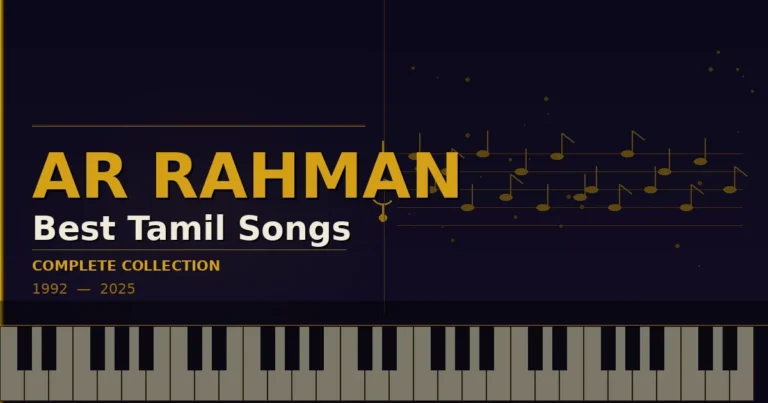
Allah Rakha Rahman is Tamil cinema’s most globally recognised export. Born in Chennai in 1966, he began composing for Tamil films in 1992 with Mani Ratnam’s Roja — and that debut alone would have secured his place in history.
Roja was not just a hit. It was a seismic shift. Rahman brought synthesisers, global influences, and a production sensibility rooted in emotional restraint rather than melodrama. The soundtrack won the National Film Award. It sold 10 million copies.
What followed was a career that jumped between Tamil and Hindi cinema while maintaining an artistic standard almost no one else has matched. In Tamil, his defining scores include Bombay (1995), Kadhal Desam (1996), Muthu (1995, joint with Deva for folk portions), Alaipayuthey (2000), Kandukondain Kandukondain (2000), and Enthiran (2010).
In 2009, Rahman won two Academy Awards for Slumdog Millionaire (Best Original Score and Best Original Song for “Jai Ho”), making him the first Indian composer to achieve this. He has also won two Grammy Awards, a Golden Globe, and a BAFTA.
Rahman’s Tamil film output is smaller than Ilaiyaraaja’s by volume, but the quality density is exceptional. Every album he has released in Tamil has been a cultural event.
Why he ranks #2: Unmatched global prestige, consistent quality across 30+ years, and a production style that put Tamil film music on international radar.
3. M.S. Viswanathan — The Golden Age Architect
M.S. Viswanathan, known universally as MSV, composed music for over 700 Tamil films between the 1950s and 2000s. He is the defining voice of Tamil cinema’s golden age.
Working in a long-running partnership with lyricist T.K. Ramamurthy (the duo was known as MSV-TKR), Viswanathan built an output of unforgettable melodies. His songs felt effortless — light, tuneful, deeply rooted in Tamil sensibility — but the arrangements were surprisingly sophisticated for their era.
Key films include Pava Mannippu (1961), Uthama Puthiran (1958), Kavikkuyil (1977), and hundreds more. His 1960s output alone contains enough material to fill several lifetimes of listening.
The Government of India awarded him the Padma Bhushan in 2017. In a career spanning six decades, he never stopped composing. He passed away in July 2023 at the age of 88, leaving behind a catalogue that is still being discovered by younger audiences on streaming platforms.
Why he ranks #3: Volume, longevity, and the sheer melodic richness of his work define what “Tamil filmi melody” means to an entire generation.
4. K.V. Mahadevan — The Classical Cornerstone
K.V. Mahadevan stands apart from most Tamil composers because his training was deeply rooted in Carnatic classical music — and it shows in every phrase. Active from the early 1950s to the late 1980s, he scored music for over 600 films across Tamil, Telugu, and Kannada cinema.
He won the National Film Award for Best Music Direction three times — a record that speaks to critical recognition beyond commercial popularity. His compositions for devotional films like Sabarimalaiyil and social dramas of the 1960s–70s remain the standard for classical-influenced Tamil film music.
Mahadevan’s legacy is particularly strong in devotional Tamil music, where his ragas-based compositions remain in active circulation. He passed away in 1991, but his influence on composers who came after him — including Ilaiyaraaja, who cited him as an early inspiration — is significant.
Why he ranks #4: Three National Awards, a classically rigorous body of work, and genuine influence on every Tamil composer who followed him.
5. Harris Jayaraj — The Melody Architect of the 2000s
When Tamil cinema entered the 2000s, Harris Jayaraj became the voice of a generation that grew up on MTV Asia and Carnatic lessons simultaneously. His music found an audience that wanted emotion and sophistication without the heaviness of classical orchestration.
Starting as a keyboardist and assistant under Ilaiyaraaja, Harris made his debut as a composer with Minnale (2001) — a soundtrack that became an instant classic. What followed was a remarkable run: Ghajini (2005), Vinnaithaandi Varuvaayaa (2010), Engeyum Kadhal (2011), and Kaakha Kaakha (2003).
His signature is lush string arrangements, melodic hooks that sit between pop and light classical, and a gift for romantic ballads that carry specific emotional weight. The Vinnaithaandi Varuvaayaa album in particular is considered one of the finest Tamil film music albums of the 21st century.
Why he ranks #5: He defines the melodic sensibility of an entire decade of Tamil cinema and remains one of the most loved composers among audiences aged 25–45.
6. Yuvan Shankar Raja — The Youth Pulse
Yuvan Shankar Raja began composing at age 16 with Kadhal Desam (1996) — and that precocity has never left his music. Son of Ilaiyaraaja, he could have coasted on legacy. Instead, he carved a completely different identity.
Yuvan brought hip-hop production, electronica, and R&B influences into Tamil film music at a time when the industry was not remotely ready for it. Albums like 7G Rainbow Colony (2004), Santosh Subramaniam (2008), and Mankatha (2011) each felt genuinely ahead of their time.
He has scored over 150 Tamil films and won five Filmfare Awards South. His collaborations with directors like Selvaraghavan (Kaadhal Kondein, Naan Kadavul) produced music that matched and amplified some of Tamil cinema’s most daring visual storytelling.
Why he ranks #6: A unique stylistic voice, cross-generational appeal, and the ability to do genre-defining work in youth films and serious dramas alike.
7. Anirudh Ravichander — The Streaming Generation’s Composer
Anirudh Ravichander arrived with a viral moment — the 2012 song “Why This Kolaveri Di” from 3 became one of the first Indian songs to trend globally on YouTube. That would have been enough for a footnote in music history. What followed has been much more.
Over the next decade, Anirudh built an output that dominates Tamil film music the way Ilaiyaraaja did in the 1980s. His BGM work — particularly for Vikram (2022) and Jailer (2023) — has set a new standard for how Tamil action cinema sounds. His melodies, meanwhile, are consistent, accessible, and production-polished in ways that travel across language barriers easily.
At 33 years old in 2026, Anirudh is still accelerating. He is the first Tamil composer to headline multiple sold-out arena concert tours internationally.
Why he ranks #7: Dominance across melody, BGM, and live performance in a streaming era where all three matter enormously — and he is still building his legacy.
8. Vidyasagar — The Understated Emotional Architect
Vidyasagar occupies a particular place in Tamil film music: he is the composer whose work people feel deeply but do not always credit loudly. His music for Autograph (2004), Kaadhal (2004), Boys (2003), and Mozhi (2007) contains some of the most emotionally precise Tamil film songs ever written.
He won the National Film Award for Best Music Direction for Autograph — a soundtrack so beloved that it is still actively streamed two decades after release. His acoustic guitar-based arrangements and folk-influenced melodies carry an intimacy that larger orchestral composers sometimes lose.
Active primarily between 1993 and 2015, Vidyasagar composed over 100 Tamil film scores. He has also done significant work in Malayalam and Telugu cinema.
Why he ranks #8: His emotionally authentic style and National Award-winning work give him a legacy that punches well above his public profile.
9. Deva — The Folk Fusion King
Deva is the composer Tamil cinema turns to when it needs to be loud, joyful, and unmistakably mass. His folk-fusion style, heavy use of nadaswaram, folk percussion, and earworm melodies defined an entire genre of Tamil entertainment films in the 1990s.
His work for Muthu (1995), Baasha (1995, shared with A.R. Rahman for certain tracks), Padayappa (1999, shared with Ilaiyaraaja), and hundreds of other films gave Tamil cinema a raw populist energy that classical or orchestral composers were not built to deliver.
With over 600 film scores, Deva is one of Tamil cinema’s most prolific composers by volume. His influence on contemporary folk-fusion and mass entertainment BGM is still audible in what composers like Anirudh produce today.
Why he ranks #9: Unmatched in the folk-commercial space, and the architect of a specific Tamil cinema sound that defined the 1990s commercially.
10. G. Ramanathan — The Man Who Started It All
No list of Tamil music composers is honest without acknowledging G. Ramanathan, who composed music for Tamil films from 1936 to the early 1980s. He is among the founding figures of Tamil film music as a formal practice.
Working across three decades when recording technology, orchestration vocabulary, and even the concept of a film soundtrack were still being invented in India, Ramanathan built a body of work that introduced Tamil audiences to the idea that film music could carry emotional narrative.
His classic compositions remain in the Tamil cultural memory even among listeners who have never consciously sought them out — because they appear in temples, on All India Radio, and in the memory of every Tamil musician trained before 1980.
Why he ranks #10: Without pioneers like Ramanathan, none of the nine composers above have a tradition to build on. Legacy demands this acknowledgment.
What Makes a Tamil Music Composer Truly Great?
Four factors consistently separate the legends from the merely popular:
1. Melodic originality — Can listeners identify a composer’s work in the first ten seconds? Ilaiyaraaja, Rahman, and Harris Jayaraj all pass this test. Their signatures are unmistakable.
2. Technical range — The best Tamil composers move across classical, folk, Western, and contemporary genres without sounding generic in any of them. Ilaiyaraaja is the clearest example of this.
3. Longevity and relevance — A composer who peaks in one decade and disappears is talented. A composer who stays culturally relevant across multiple decades is great. Ilaiyaraaja, M.S. Viswanathan, and A.R. Rahman all qualify.
4. Film-music fit — Tamil film music is not concert music. It serves drama, character, and emotion. The greatest Tamil composers — every one on this list — understand that the film is the canvas, not the auditorium.
Common Myths About Tamil Music Composers
Myth: A.R. Rahman is more prolific than Ilaiyaraaja in Tamil cinema. False. Rahman has composed for roughly 100–120 Tamil films. Ilaiyaraaja has scored over 1,000. Rahman’s global visibility is higher; Ilaiyaraaja’s Tamil output is exponentially larger.
Myth: Tamil film music only became sophisticated after Ilaiyaraaja. Incorrect. K.V. Mahadevan’s classical work, M.S. Viswanathan’s sophisticated melodic arrangements, and G. Ramanathan’s pioneering compositions show that Tamil film music was technically mature before Ilaiyaraaja arrived — he simply exploded its possibilities.
Myth: Anirudh Ravichander is too young to rank among the greats. His career started in 2012. By 2026, he has 80+ Tamil film scores, multiple award wins, global concert tours, and two of the highest-grossing Tamil film soundtracks in history (Vikram, Jailer). Legacy is built from what you produce, not from age.
Myth: Tamil film music and Tamil classical music are separate worlds. The best Tamil film composers — particularly Ilaiyaraaja and K.V. Mahadevan — drew directly from Carnatic classical music and wove it into popular film songs. The boundary between classical and cinematic in Tamil music has always been porous.
Frequently Asked Questions
Who is the most famous Tamil music composer in the world?
A.R. Rahman is the most globally recognised Tamil music composer. His two Academy Awards, two Grammy Awards, and Golden Globe make him the only Tamil composer with that level of international recognition. Within Tamil Nadu itself, Ilaiyaraaja is considered the greater cultural figure by most music historians and fans.
How many films has Ilaiyaraaja composed music for?
Ilaiyaraaja has composed music for over 1,000 films — a figure confirmed by multiple sources including Guinness World Records. This spans Tamil, Telugu, Kannada, Malayalam, and Hindi cinema, across five decades of active work from 1976 to the present.
Is Yuvan Shankar Raja Ilaiyaraaja’s son?
Yes. Yuvan Shankar Raja is the son of Ilaiyaraaja and began his composing career at age 16 with the 1996 Tamil film Kadhal Desam. He has built a completely independent artistic identity, known for hip-hop influences and youthful energy that differs markedly from his father’s classical-fusion style.
What Tamil film has the best music of all time?
This is a genuinely contested question, but several soundtracks consistently appear in critical rankings: Ilaiyaraaja’s Nayagan (1987) and Mouna Ragam (1986), A.R. Rahman’s Roja (1992) and Alaipayuthey (2000), and Harris Jayaraj’s Vinnaithaandi Varuvaayaa (2010). Each defines a different era.
Which Tamil composer has won the most awards?
Ilaiyaraaja holds the most total career awards in Tamil film music, including National Film Awards, Filmfare Awards South, and international honours. A.R. Rahman holds the most globally prestigious awards. K.V. Mahadevan won the National Film Award for Best Music Direction three times — a category-specific record.
Are there any great Tamil female music composers?
Tamil film music has historically been male-dominated in composition roles. However, Aruna Sairam, while primarily a classical vocalist, has influenced film music significantly. Contemporary composers like Santhosh Narayanan’s collaborations have opened more doors. The industry’s gender gap in composition is a genuine and ongoing critique.
What is the difference between Ilaiyaraaja’s and A.R. Rahman’s styles?
Ilaiyaraaja’s style is rooted in Western classical orchestration blended with Carnatic and folk traditions — rich, complex, and often introspective. Rahman’s approach leans on world music synthesis, electronic production, and a layered sonic texture that feels global even when drawing on local roots. Ilaiyaraaja is more symphonically dense; Rahman is more sonically spacious.
Which Tamil composer is most popular with younger audiences today?
Anirudh Ravichander dominates among Tamil listeners aged 15–35 as of 2026. His streaming numbers, social media presence, and sold-out concert tours give him the widest reach of any currently active Tamil composer among youth audiences globally.
Conclusion
Tamil film music has produced an extraordinary concentration of compositional genius across 90 years of cinema. From G. Ramanathan’s pioneering classical foundations to Anirudh Ravichander’s streaming-era dominance, the tradition is both continuous and constantly renewed.
If you are discovering Tamil music for the first time, start with Ilaiyaraaja’s Mouna Ragam soundtrack, then move to A.R. Rahman’s Roja — two albums that will tell you everything about what this tradition is capable of.
If you are a longtime fan, revisit Vidyasagar’s Autograph or Harris Jayaraj’s Vinnaithaandi Varuvaayaa. There is still depth in both that rewards re-listening.
The composers on this list did not just write songs. They built an entire sonic world. That world is still being built today.
Ready to take the next step? Our expert posts are here to guide your journey forward